

Do You Know Which Agents Can Take Actions in Your Environment?

Most organizations today can tell you which users have access to which systems. Many can also tell you which APIs are exposed, which services are running, and which models are deployed.
But very few can answer a much simpler, and more dangerous, question:
Which AI agents can actually take actions in your environment right now?
Not generate text. Not suggest recommendations. Take actions.
From “AI that answers” to “AI that acts”
We are quietly crossing a line.
AI is no longer limited to analysis or content generation. Agents today can:
Call internal APIs
Modify configurations
Trigger workflows
Interact with production systems
Chain tools autonomously
In other words, they operate.
Once an agent operates, the discussion is no longer about model quality or prompt safety. It becomes a question of governance, control, and accountability.
The uncomfortable reality
In most environments today:
There is no clear inventory of action-capable agents
There is no single owner accountable for their behavior
There is no runtime enforcement layer
There is no reliable audit trail connecting intent → action → impact
Guardrails focus on prompts and outputs. IAM focuses on humans and services. Security tooling focuses on infrastructure.
None of them were designed to control autonomous decision-making entities at runtime.
The invisible risk
The most dangerous agents are rarely external attackers.
They are often:
Internal automations
Experimental copilots
Proof-of-concept agents that quietly reached production
Agents operating under inherited or overly broad service privileges
They do not appear malicious. They appear “helpful”.
Until something goes wrong, and no one can clearly explain who authorized the action, under what intent, or how to stop it immediately.
Why this is not a traditional security problem
This is not an IAM problem. It is not an LLM safety problem. And it is not a SOC tooling gap.
This is a control-plane problem.
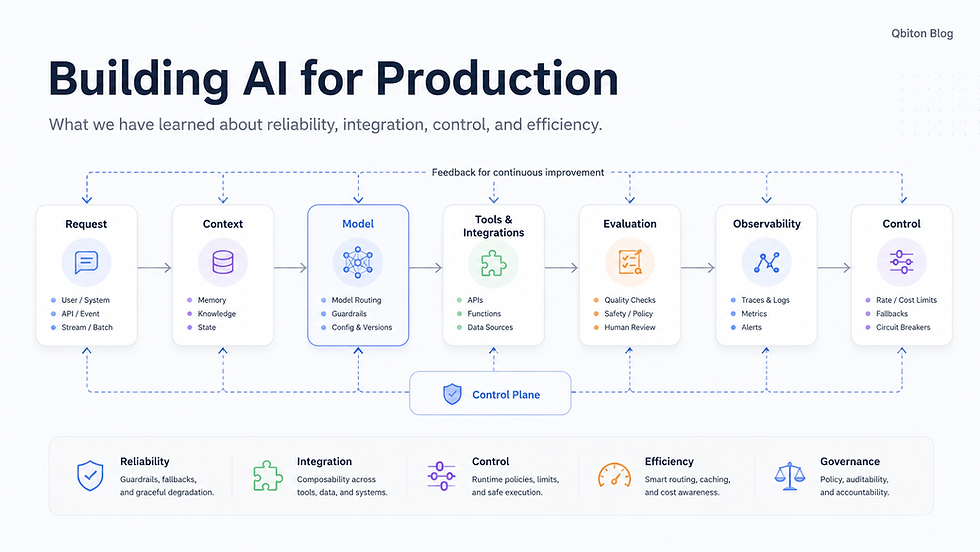
When agents can act, organizations need:
Explicit identity for non-human actors
Clearly defined intent and operational boundaries
Runtime checkpoints before execution
Continuous risk scoring and auditability
The ability to isolate or stop a single agent without disrupting everything else
Without these controls, agents operate on implicit trust — the most fragile trust model in complex systems.
A simple test for any organization
Ask yourself three questions:
Can we list all agents that can perform actions today?
Can we explain why each one is allowed to act?
Can we stop a single agent immediately, without shutting down the entire environment?
If any of these answers is unclear, this is not an AI maturity issue. It is a governance blind spot.
The shift that needs to happen
As AI systems move from assistive to autonomous, organizations must shift from:
Model-centric thinking → Actor-centric thinking
Output safety → Action safety
Static permissions → Dynamic runtime control
This is not about slowing innovation. It is about making autonomy observable, controllable, and survivable.
How this is being addressed at Qbiton
At Qbiton, we develop technologies to secure AI agents and other non-human actors, as well as to protect operational environments from the actions those actors perform.
Our focus is on the governance and control layer around action-capable non-human actors — AI agents, automations, and internal AI services — rather than on models, prompts, or infrastructure security.
In practice, this means helping organizations:
Identify and make visible which agents can take actions
Establish clear accountability for non-human actors
Define intent, scope, and operational boundaries for agent behavior
Introduce runtime oversight and auditability for agent actions
This approach is being validated through hands-on proof-of-concepts in GPU-based AI environments, including NVIDIA-based infrastructures.
The objective is not to block autonomy, but to ensure that autonomous behavior remains controlled, observable, and explainable.
Final thought
The question is no longer “Can our agents do this?” It is “Should they be allowed to, and under what conditions?”
If you do not know which agents can take actions in your environment, someone else, or something else, effectively does.
And that is not a position any organization intends to be in.


Comments